The Inexpressible



“Perhaps what is inexpressible
(what I find mysterious and am not able to express)
is the background against which
whatever I could express has its meaning”
—Ludwig Wittgenstein, Culture and Value.
eee fff
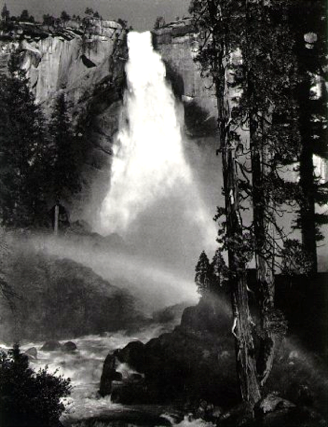
Ansel Adams’ Nevada Fall, Rainbow, Yosemite Valley, 1947
There is that which can be expressed.
There is that which cannot be expressed.
The first sentence is uncontroversial to the degree wherein the only perplexity is why one would bother to make such an assertion--of course there is that which can be expressed: any expression is of that which can be expressed by its very nature as an expression. The second sentence seems more worthy of a moment’s reflection, albeit, only a moment, for that is all it takes to ask about the “cannot,” specifically, why?
There are two degrees of possible answers to the “cannot:”
First, the very logical answers: perhaps someone is physically incapable of expressing something (bound, muted, out of sight, etc.); perhaps someone has been threatened to not express anything; taken an oath or made a promise to not do so; lacks the authority or right to respond; lacks the vocabulary, etc.
But then there are more complicated answers: perhaps one cannot express something because it is beyond the limits of discourse, knowledge, and/or experience.
The immediate trouble with these more complicated answers is the “there is” in the assertion: “There is that which cannot be expressed.” (“There is” [Il y a] has troubled enough contemporary Continental philosophy so as to become almost a technical term; beyond Lyotard, see especially Levinas.)
Why is “there is” trouble?
-This is an ontological claim—one about being—that asserts something’s existence.
-If we can assert its existence, this is also an epistemological claim—one about knowledge—we must know it to exist.
-If we know it exists, this is also a metaphysical claim—one about being and reality—because to have acquired this knowledge, we must have been able to experience it (rationally, empirically, or otherwise).
Thus, the “there is” undermines and denies the possibility that the “cannot” could be because of the something being beyond the limits of discourse, knowledge, and/or experience. For us to make the assertion, we have already established that there is something within the limits of being, discourse, knowing, and experience.
So… all of the logicians and grammarians will dismiss all of these complicated reasons as impossible, illogical, or, just a misunderstanding or imprecise use of language.
But do we want to accede to the logicians and grammarians?
In addition to the vast and diverse canon that testifies to the existence of the inexpressible, we can also call on our own experiences and thinking. We can conceive of limits to logic; if we can think limits, we can also think about that which is beyond those limits—even if not as content, but as a possibility of such. Even without becoming relativists, we can think about why we should not close off possibilities, not trust absolutes, certainties, an over-reliance on reason, or facts. We can remain humble and hopeful that there is more than we can affirmatively grasp with logic.
We will not say for certain that there is that which cannot be expressed, but we will hold it open as a possibility to explore this semester.
And we can come up with some possibilities as to what this inexpressible is:
What is the inexpressible? Classically, it is identified as the experience of the divine and of the sublime, the overwhelming and awe-inspiring, the logically impossible being or event, or the unbelievable. It has been identified as disparately as seeing God or feeling love or surviving incomprehensible horror. What unites this diversity is the feeling of being impelled, yet unable, to express … something … that experience that resists its being encapsulated.
“Perhaps what is inexpressible (what I find mysterious and am not able to express) is the background against which whatever I could express has its meaning” (Wittgenstein, Culture and Value). And, no matter how formative to the foreground, constitutive of their very meaningfulness, backgrounds cease to be backgrounds when called forth and put into speech. What does a background cum foreground look like? How do we talk about it? Is it formative of meaning exclusively while background, or also when foreground? Does language say what it means? What is meaning? These linguistic and epistemological questions must be addressed. If the background is formative of meaning, then we see expression or the event that prompts it to be constitutive of a reality (any phrase yields four metaphysical building blocks: an addressor, addressee, sense, and referent--the expression links them, forms them). “For there to be no phrase is impossible …. It is necessary to make linkage. This is not an obligation … but a necessity …” (Jean-François Lyotard, The Differend). And as a necessity, yes, for logic, but also as an obligation for ethics. Expressions create links, relations between people and things and modes and places and times... these may be expressible by reason or they may be receivable by the greater perceptual apparatus (aisthesthai: to perceive, which gives us our word aesthetics). Expression, being greater than the written or spoken alone, also demands that we tackle these ethical and aesthetic questions.
Thus, if we grant the possibility of there being the inexpressible, how do we respond to its call and actually express the inexpressible? Again, the logicians and grammarians will declare it an absurdity: a tautology at best and an impossibility at worse. But the artists and theologians will declare it a vocation. We philosophers may sigh and call it futile and/or necessary—in fact, the greatest task of both, and thus, our greatest task. By its being a paradox, it provokes us. It is an epistemological puzzle and a moral obligation. It calls to us, and to it, we must respond. All are summoned to language and by language “to recognize that what remains to be phrased exceeds what they can presently phrase, and that they must be allowed to institute new idioms which do not yet exist” (Lyotard, The Differend).
This course will explore the inexpressible in three interrelated instantiations: the epistemological/ethical, the spiritual, and the aesthetic. The distinctions between them are false, yet divulges the breadth and blurriness of our topic. Close textual analyses will be undertaken on four texts—Jean-François Lyotard’s The Differend: Phrases in Dispute, Chuang Tzu’s Basic Writings, Pseudo-Dionysius’ The Divine Names, and Immanuel Kant’s Critique of the Power of Judgment—with ample supplementation from selections of the transcripts of the Nuremberg Trial, Zeno’s paradoxes and modern logic puzzles, medievals representing all three Abrahamic traditions, contemporary philosophers, scholars, critics, and artists on the aesthetic, and engagements with art itself in many mediums. The theoretical content of the course calls us to the intellectual practice of the most intense problem solving—the inexpressible “becomes a mini detective story, an enigma; it requires a search for something other than what is stated; it introduces endless details having the value of clues” (Michel de Certeau, The Mystic Fable) and “we want to think thoughts that cannot be thought” (John D. Caputo, The Weakness of God)—as we individually and collectively feel our way through the philosophical conundrum of the possibility and/or impossibility of bearing witness to that which repels testimony.
eee fff
eee fff
Contradictions are valuable and this class will seek as many as it can. It will be, I can guarantee, an intellectually rigorous ride through chaos that will demand a great deal of curiosity and fortitude through frustration and will command a great deal of personal reflection and participation.
The challenge will consist in trying to understand what eludes capture without requiring too firm of a grasp, as the inexpressible will never be had for it to be, truly, inexpressible. We will begin a task, then, that will fail, that must fail, or else it risks destroying its own aim and activity. At times we will become normative thinkers and seek the most rigorous definitions of ideas that we will encounter, but at other times we must learn to look at philosophy the way we look at art: we must reflect long and entertain many conflicting theses and, ultimately, ask how it makes us feel.
Please see the syllabus (here) for the practical course information
“What if the book were only infinite memory of
a word lacking?
Thus absence speaks to absence”
—Edmond Jabès, “Adam, or the Birth of Anxiety.”
About the Thinkers and Books that we will Cover:
1. Jean-François Lyotard’s The Differend:
(1924-1998; b. Versailles, France; buried in Paris) Educated at the Sorbonne, taught in French East Algeria, Université de Paris VIII (almost 20 years), lectured worldwide, including longer stays at University of CA Irvine, San Diego, and Berkeley, Johns Hopkins, Yale, and Emory, also the Université de Montréal and Universidade de São Paulo.
Lyotard’s background is full of incendiary influences and contrasts:
Philosophically, he was grounded in phenomenology (the contemporary methodology/school founded by the German philosopher Edmund Husserl in the early 1900’s; it is primarily a method of examining how things present themselves to an individual consciousness without bias), yet also its critic; he participated in phenomenology’s off-shoot and opposite, the critique of structuralism and yet is also a critic of post-structuralism, and is widely named the “Father” of postmodernism.
He was very politically active in, first, radical Marxian and then anti-Marxian politics and influenced by Freudian and anti-Freudian psychoanalysis. In 1954 he joined Socialisme et Barbarie, a radical political group concerned with how the Soviet Union was misusing Marx and how Trotskyian analysis was unable to foresee and counter the SU’s authoritarianism and then helped to found a splinter group Pouvoir Ouvrier (v. to be able, n. worker; idiomatically could translate as something like working capacity, with allusion to puissance, power; during which his writings were focused on the French-Algerian conflict), before quitting his political stances in 1963.
He also contributed a great deal to both aesthetics and art criticism (esp. avant-garde art). Aesthetics is employed throughout all his works, especially if we understand it originally as Aisthesthai, the Greek verb “to perceive.” A “red thread” through all his diverse influences and writings is his desire to present what is left unpresented.
“Postmodernism,” for Lyotard, means something very different than how the term is used in the everyday market place of contemporary theories and catch-phrases. It is neither a diachronical next period after the modern nor is it the modern’s overturning by an interruption of linearity through an eclecticism or roughshod assembly of artifacts. Instead, postmodernism is primarily methodological and purports an anti-historicism and active uncovering of bias akin to Husserl’s phenomenology. Its endeavor is to lay bare what otherwise remains un-presented or covered over. Lyotard prefers to name it “re-writing modernity” to emphasize its persistent re-velation and re-address of the prejudicing and fictive grand narratives to which our thought so easily succumbs.
The Differend is his most notable and most challenging work. In it, he is seeking to understand and see if he can resolve “differends,” that is, conflicts with an insurmountable gulf between them. In it, he seeks to understand all the cases where differends arise, in law, in grammar, in logic, in the history of philosophy, and in everyday life and speech.[1] Accordingly, his writing is fragmentary and nonlinear; it embraces numerous styles and stylistic devices; it intersperses textual analyses of texts, mainly philosophical, but also legal and literary, amongst chapters broken into numbered and occasionally titled sections.
2. Pseudo-Dionysius’ The Divine Names:
Presumably Syrian (ca. 471-528 c.e.[2])
While there are many subtle difficulties to encapsulating Pseudo-Dionysius’ thought, the most profound stump is that he is, precisely, a pseudonym. Pseudo-Dionysius is not Dionysius the Areopagite—a distinguished convert of St. Paul in Acts 17 and an Athenian member of the judicial council. He who unremittingly invoked the power of names to permit one to know their creator, refuses us his own, truthful name. Thus, we call him “Pseudo-Dionysius,” which does have a more eloquent ring than the name offered by Erasmus and used by Luther: “Dionysius the whoever-he-was” (Rorem, Pseudo-Dionysius, 17). His pseudonym also successfully expresses the nebulous quality in the union of potentially conflicting sources that compose his intellectual background: Neoplatonism and Christianity.
The Divine Names is a notable and relatively brief third treatise out of four existent (plus ten letters).
The four surviving treatises:
The Celestial Hierarchy, which delineates the ranks of angels.
The Ecclesiastical Hierarchy, which delineates the ranks of religious figures.
The Divine Names, which undertakes a study of the intelligible names applied to God (i.e., Goodness, Wisdom, Yearning, etc.).
The Mystical Theology, which philosophically prompts one to abandon the sensible and intelligible in order to experience a union with God.
The two debated treatises are the Theological Representations (Outlines of Divinity), which was said to be on the trinity and incarnation, and the Symbolic Theology, which reputedly analyzed the sensible names representing God (i.e. Rock, Right Hand, etc.).
His writings total less than 250 pages all together, yet his work is difficult in both writing and content. He loved words and their poetry, he uses puns and analogies and all sorts of word play and wrote such in the attempt to accomplish the impossible: describe the indescribable. To this end, he fused together affirmation and denial.
3. Chuang Tzu’s Chuang Tzu: Basic Writings
Little is known about who Chuang Tzu (aka Master Chuang or Chuang Chou) was; a brief record in the Shih chi, the Records of the Historians, tells us that he was a native of Meng, likely in the State of Sung, an official in the “lacquer garden,” was a contemporary of Mencius, and wrote a fable-like book of over 100,000 words. The state of Sung existed in a uncertainty: continually threatened by neighboring states, suffering a great deal of internal conflict, and composed of people characterized as full of despair, oppressed socially and politically, and generally born of weakness and anguish. If this was his homeland, it provides a striking background for Chuang Tzu’s writings, which reveal a deep level of mystical detachment and a bitingly humorous skepticism that stands in glaring contrast to the optimistic and strong writings of Confucius and Mencius.
Chuang Tzu is known as the second greatest Taoist, after Lao Tzu, although his work, also known as the Chuang Tzu, reveals itself to have interesting differences from the writings of the school’s founder in both content and style. Chuang Tzu answers their shared question of how the individual ought to live in the messed up world by going a step beyond his master into the mystical, incommunicable realm. Lao Tzu establishes the Tao as the principle of harmony; it is an ideal, a simplicity, to which humanity and society must strive (even if this striving is wu wei, a non-action). Chuang Tzu, on the other hand, while agreeing in the primacy of the Tao, that it is an underlying harmony of utmost value, he does not actively promote a return to it in simplicity, but, rather, his main theme is FREEDOM. This is a freedom from external restraints that is not an asceticism, but a mental break from prejudice and conventional thinking. Thus, to concretize his answer, it would be: Free yourself from the world! The delivery of this message will attempt to enact a freeing by being conveyed through paradoxical quips, fanciful fables, incomprehensible logics, and pure humor.
4. Kant’s Critique of the Power of Judgment:
(1724-1804) b. Königsberg (cap. Of province of East Prussia, became part of Germany, not in Russia; but we consider him a German philosopher). Born there and never really left, never traveled more than about 40 miles from home and lived a very strict, secluded, and predictable life (set watches by his daily walks) and, despite being the preeminent thinker of aesthetics, his exposure to artworks was quite limited. Studied mathematics, physics, physical sciences, and all forms of philosophy. He lectured as a private tutor for nine years and a Privatdozent (non-salaried instructor) for 15 years before being appointed Professor of Logic and Mathematics at the U of Königsberg at 45 (in 1770).
His most invaluable contribution to Western Philosophy is his three-part Critical Project:
The first, Critique of Pure Reason (1781, 1787), addresses knowledge, the second, Critique of Practical Reason (1788), ethics, and the third, Critique of the Power of Judgment (1790), aesthetics and teleology (from telos, end, purpose, or goal).
For Lyotard, however, and how we will consider Kant in this class, is for his Third Critique:
“I believe, first of all, that one cannot avoid returning to the ‘Analytic of the Sublime’ in Kant’s Third Critique, at least, that is, if one wants to have an idea of what is at stake in modernism, especially in the avant-gardes in painting and music.”[3]
The Critique of the Power of Judgment is the third in the trilogy of his Critiques. What we will read will focus on the sublime, that is, the aesthetic matter that stands in contrast to the beautiful and is understood as that which creates in us an awe, an inability to understand it rationally. His writings, often considered as dry as hay, are very rigorous and rational. They may read slowly, but do have greater clarity, like Aristotle’s work, than the others’, due to having more linear, argumentative structure.
Many scripture writers will tell you that the divinity is not only invisible and incomprehensible, but also “unsearchable and inscrutable,” since there is not a trace for anyone who would reach through into the hidden depths of this infinity. And yet, on the other hand, the Good is not absolutely incommunicable to everything”
--Pseudo-Dionysius, The Divine Names, Op. Cit., 588C
Summary of the Main Theme we will Cover:
We are going to read four texts: from an Ancient Chinese, a medieval Syrian, a modern German, and contemporary Frenchman on undoing logic, God, the sublime, and differends. These seemingly straightforward topics will be interwoven with questions of ethics and logic, politics and humanism, literary theory and musical composition, metaphysics and religion. This profusion, then, will be further supplemented with readings from the Nuremberg Trial testimony, ancient Chinese Taoism, poetry, and viewings and encounters with classic to modern and avant-garde art, classic and postmodern film, and experimental music. This chaos will kinetically generate a cohesion through the theme expressing the inexpressible.
NOTES:
[1] Irigaray’s The Way of Love nicely captures the everyday differend that naturally surfaces between people: “The rift between the other and me is irreducible. To be sure we can build bridges, join our energies, feast and celebrate encounters, but the union is never definitive, on pain of no longer existing. Union implies returning into oneself, moving away, dissenting, separating. To correspond with one’s own becoming requires an alteration of approaching the other and dividing from him, or her” (Luce Irigaray, The Way of Love, trans. Heidi Bostic and Stephen Pluhacek (London: Continuum, 2002), 157).
[2] This incorporates the scholarly dispute between his birth of ca. 471 or 485 and his death of 518 or 528.
[3] Jean-François Lyotard, “After the Sublime: The State of Aesthetics,” in The States of “Theory”: History, Art, and Critical Discourse, ed. David Carroll (New York: Columbia University Press, 1990), 297-304, 297.
“What we cannot speak about
we must pass over in silence”
—Ludwig Wittgenstein, Tractatus Logico-Philosophicus.
“What cannot be put into words
should not be suppressed”
—Jean-Luc Marion, L’idole et la distance.
Painting: Sam Francis’ All I See is not There



Introduction and Overview