Syllabi






“What we cannot speak about we must pass over in silence”
–Ludwig Wittgenstein, Tractatus Logico-Philosophicus.
“What cannot be put into words should not be suppressed”
–Jean-Luc Marion, L’idole et la distance.
What is the inexpressible? Classically, it is identified as the experience of the divine and of the sublime, the overwhelming and awe-inspiring, the logically impossible being or event, or the unbelievable. It has been identified as disparately as seeing God or feeling love or surviving incomprehensible horror. What unites this diversity is the feeling of being impelled, yet unable, to express … something … that experience that resists its being encapsulated.
“Perhaps what is inexpressible (what I find mysterious and am not able to express) is the background against which whatever I could express has its meaning” (Wittgenstein, Culture and Value). And, no matter how formative to the foreground, constitutive of their very meaningfulness, backgrounds cease to be backgrounds when called forth and put into speech. Yet, “for there to be no phrase is impossible …. It is necessary to make linkage. This is not an obligation … but a necessity …” (Jean-François Lyotard, The Differend).
Thus, how do we actually express the inexpressible? The logicians and grammarians will declare it an absurdity: a tautology at best and an impossibility at worse. The artists and theologians will declare it a vocation. We philosophers may sigh and call it futile and/or necessary—in fact, the greatest task of both, and thus, our greatest task. By its being a paradox, it provokes us. It is an epistemological puzzle and a moral obligation. It calls to us, and to it, we must respond. All are summoned to language and by language “to recognize that what remains to be phrased exceeds what they can presently phrase, and that they must be allowed to institute new idioms which do not yet exist” (Lyotard, The Differend).
This course will explore the inexpressible in three interrelated instantiations: the epistemological/ethical, the spiritual, and the aesthetic. The distinctions between them are false, yet divulges the breadth and blurriness of our topic. Close textual analyses will be undertaken on four texts—Jean-François Lyotard’s The Differend: Phrases in Dispute, Chuang Tzu’s Basic Writings, Pseudo-Dionysius’ The Divine Names, and Immanuel Kant’s Critique of the Power of Judgment—with ample supplementation from selections of the transcripts of the Nuremberg Trial, Zeno’s paradoxes and modern logic puzzles, medievals representing all three Abrahamic traditions, contemporary philosophers, scholars, critics, and artists on the aesthetic, and engagements with art itself in many mediums. The theoretical content of the course calls us to the intellectual practice of the most intense problem solving—the inexpressible “becomes a mini detective story, an enigma; it requires a search for something other than what is stated; it introduces endless details having the value of clues” (Michel de Certeau, The Mystic Fable) and “we want to think thoughts that cannot be thought” (John D. Caputo, The Weakness of God)—as we individually and collectively feel our way through the philosophical conundrum of the possibility and/or impossibility of bearing witness to that which repels testimony.
I. COURSE GOAL and OBJECTIVES:
The goal of this course is to collectively uncover the fundamental importance of expression and its failure to all branches of philosophical inquiry and everyday life. This goal necessitates the breadth of investigation to transgress boundaries between disciplines and yet be balanced with the honing of critical thinking through close textual reading. It also necessitates the merger of theory and practice in drawing our content from and turning our activity to both texts and life. Close reading and critical thinking, inward and outward reflective awareness, and challenging writing and thoughtful dialogue are all skills and art forms whose cultivation will better an individual regardless of his or her academic concentration and future career path.
II. COURSE POLICIES and REQUIREMENTS:
REQUIRED TEXTS:
Jean-François Lyotard, The Differend, trans. Georges Van Den Abbeele (Minneapolis, University of Minnesota Press, 1988), isbn: 0816616116, $19.50.
Pseudo-Dionysius, The Divine Names in The Complete Works, trans. Colm Luibheid (Mahwah, NJ: Paulist Press, 1987), isbn: 0809128381, $24.95.
Chuang Tzu, Chuang Tzu: Basic Writings, trans. Burton Watson (New York: Columbia University Press, 1996), isbn: 0231105959, $26.00.
Immanuel Kant, Critique of Judgment (Cosimo Classics, 2007), isbn: 160206542X, $14.95.
Supplemental readings/viewings will be provided by photocopy in class or electronically on our website.
ATTENDANCE:
Attendance is strongly encouraged. If you do not come to classes it will make it nearly impossible for you to positively contribute to class and very difficult for you to achieve solid academic progress into the material, in turn making it all the more difficult for you to craft superior papers. Since such is foundational to the main grade determinants, it makes very good sense for you to come to all classes. If a class is missed, one is still responsible for the material due and covered that day. Please notify me in the case of excusable absences. Each student is fully responsible for verifying and correcting, if necessary, his/her registration status.
ASSIGNMENTS:
Textual Analyses: Three two-page papers that perform close textual analyses of a brief selection of text that presents a problem, question, something remarkable, or otherwise demonstrated to be noteworthy to you. The basic structure should include a summary of the selection that carefully works through what it is saying, a contextualization of it in the work, and a thorough explanation of its interest.
Class Presentation: An oral presentation given to the class that summarizes some of the main arguments of a reading on an assigned day that concludes with a discussion question or prompt for the class.
Midterm Paper: An eight-to-ten page paper that explores questions contingent to the topic of the inexpressible predominately through Lyotard’s The Differend. Questions will be provided in class upon which to write, including an option to design your own. Supplemental research is permitted, but not required.
Final Project: A greater-than-ten page (or equivalent) paper or project. While prompts will be given for topics, this is an ideal opportunity for the individual construction of a topic. Anything outside of a resemblance to an academic paper must be accompanied by an ‘artist’s statement’ of appropriate length to fully explicate the theoretical connection of the project to the topic and course. Each student will be required to meet at least once with me to discuss his/her project.
EXTRA CREDIT ASSIGNMENTS:
A) Read one of the following selections (available online, in library, or request a copy from me) and write a three page, typed analysis that clearly summarizes the material, delineates its main arguments, and closely evaluates its meaning (are its arguments effective, is it persuasive overall, and why or why not?).
Jean-Louis Chrétien’s The Call and the Response, ch.1 (contemporary French philosopher-theologian).
Julian of Norwich’s Revelations of Divine Love, chs.1-5 (14th c. female Christian mystic; available at: http://www.ccel.org/ccel/julian/revelations.toc.html).
Augustine’s Confessions, Bk.1-2 and/or Bk.10 (4th c. Church father, first autobiography; available at: http://www.ccel.org/ccel/schaff/npnf101.vi.html).
Walt Whitman’s Leaves of Grass (19th c. extended philosophical poem; available at: http://whitmanarchive.org/published/LG/index.html).
Jean Paul Sartre’s Nausea (existential novella; available at: http://users.telenet.be/sterf/texts/phil/Sartre-Nausea.pdf).
Jorge Luis Borges’ “The Library of Babel” in Labyrinths (philosophic short story; available at: http://jubal.westnet.com/hyperdiscordia/library_of_babel.html).
Rabi’a’s Doorkeeper of the Heart (8th c. female Sufi mystic).
Kierkegaard’s “Seducer’s Diary” in Either/Or (philosophical-literary account of seduction)
André Bréton’s Manifesto of Surrealism (“father” of French surrealism; available at: http://www.tcf.ua.edu/Classes/Jbutler/T340/SurManifesto/ManifestoOfSurrealism.htm).
B) Select and watch one of the films listed below and write a three page typed analysis including a basic plot summary highlighting details philosophically relevant to the inexpressible and your thorough evaluation of it as both an aesthetic and theoretical presentation.
Igmar Bergman’s “Winter Light” (Swedish, 1962), “Silence” (1963), “Through a Glass Darkly” (1961).
Akira Kurosawa’s “Rashomon” (Japanese, 1950).
Alain Resnais’ “Light and Fog” (French, short film/documentary, 1955).
Krzysztof Kieslowski’s “Blue” (Polish, but film subtitled from French, 1993).
Andrey Tarkovsky’s “Stalker” (Russian, 1979), “Solaris” (1972).
David Lynch’s “Lost Highway” (American, 1997), “Inland Empire” (2006).
Alejandro Gonzàlez Iñárritu’s “Babel” (Mexican, but film predominately in English, 2006).
Katsuhiro Ohtomo’s “Akira” (Japanese, animation, 1988).
Khyentse Norbu’s “Travellers and Magicians” (Bhutanese, 2003).
Robert Zemeckis’ “Contact” (American, 1997).
Edward Zwick’s “Courage Under Fire” (American, 1996).
Hiroshi Teshigahara’s “Woman in the Dunes” (Japanese, 1964).
Alejandro Jodorowsky’s “The Holy Mountain” (Mexican, 1973).
Jan Svankmajer’s “Little Otik” (Czech Republic, stop-gap animation, 1988).
Wim Wender’s “Wings of Desire” (German, 1987).
Godfrey Reggio’s “Powaqqatsi” (American, artistic documentary, 1988).
If more extra credit assignments are desired, please see me (i.e., there is no maximum cap on the number of extra credit assignments you may complete).
GRADE DISTRIBUTION:
Contribution: 10% of your final grade. Textual Analyses: each worth 10%, thus, 30% together. Class Presentation: 10%. Midterm Paper: 25%. Final Project: 25%. Each extra credit assignment completed successfully will be worth up to five points added to your lowest scoring assignment.
GRADE SCALE:
All assignments will receive an alphabetic and/or numeric grade based upon their demonstrated quality of thought and effort. The scale will be: A (100-96); A- (95-92); B+ (91-88); B (87-84); B- (83-80); C+ (79-76); C (75-72); C- (71-68); D+ (67-64); D (63-60); D- (59-56); F (55-0). Any grade disputes will be settled by personal meeting where we will review together the totality of your class work.
EVALUATION CRITERIA:
Writing will be evaluated by both quality of content (thoughtful and well-explicated and -supported analysis) and by quality of writing (grammatically correct work at least and evidence of one’s attention to style and good writing at best). Contribution will be evaluated by your attendance and participation—the former means in both body and mind, thus sleeping or incessant texting, etc., will be considered non-attendance, and the latter means participation very broadly construed so to include active attention, verbal participation in discussions, evidence of such in the written incorporation of ideas born from discussions, and overall preparation of the assignments.
ELECTRONIC SUPPLEMENTS and NOTES:
Our course Blackboard site (accessible through your BIC account) will collect various additional, optional readings. In addition, while their consultation is not required, helpful summations of course lectures and additional materials both directly related and tangential to course material will be provided on our class website at: http://web.mac.com/aquestionofexistence, under the “The Inexpressible” tab.
III) UNIVERSITY POLICIES:
HONOR CODE:
The Belmont community values personal integrity and academic honesty as the foundation of university life and the cornerstone of a premiere educational experience. Our community believes trust among its members is essential for both scholarship and effective interactions and operations of the university. As members of the Belmont community, students, faculty, staff, and administrators are all responsible for ensuring that their experiences will be free of behaviors which compromise this value. In order to uphold academic integrity, the university has adopted an Honor System. Students and faculty will work together to establish the optimal conditions for honorable academic work. Following is the Student Honor Pledge that guides academic behavior:
“I will not give or receive aid during examinations; I will not give or receive false or impermissible aid in course work, in the preparation of reports, or in any other type of work that is to be used by the instructor as the basis of my grade; I will not engage in any form of academic fraud. Furthermore, I will uphold my responsibility to see to it that others abide by the spirit and letter of this Honor Pledge.”
Thus, I have a zero-tolerance policy for academic dishonesty and especially for any form of plagiarism. Plagiarism includes, but is not limited to the summary, paraphrase, or direct quotation of either published or unpublished work of another without full and clear citation. Consequences for academic dishonesty will result in a zero score on the assignment and possible further repercussions in accordance with school policy. If you have questions about plagiarism or academic honesty in general, please consult the school handbook, one’s academic advisor, or me.
ACCOMMODATION OF DISABILITIES:
In compliance with Section 504 of the Rehabilitation Act and the Americans with Disabilities Act, Belmont University will provide reasonable accommodation of all medically documented disabilities. If you have a disability and would like the university to provide reasonable accommodations of the disability during this course, please notify the Office of the Dean of Students located in Beaman Student Life Center (460-6407) as soon as possible.
COURSE EVALUATIONS:
The university urges and expects all students to participate in all course evaluations, providing honest feedback to the instructor and institution about the specific aspects and elements of the course. Outside of the official evaluations, I highly encourage you to provide me with feedback about the course and engage in dialogue so as to take an active engagement with the “how” of your education, as well as with the “what” that we cover.
IV) READING and ASSIGNMENT SCHEDULE:
Please note that the reading schedule is subject to change;
announcements of such changes will be made in class.
All handouts, optional readings that are not in the class texts, and art selections will be available on our external class website at: http://web.mac.com/aquestionofexistence/Site/The_Inexpressible/The_Inexpressible.html
August
Thurs. 25
Introduction
Tues. 30
(1) Lyotard’s The Differend, “Preface: Reading Dossier,” pp.xi-xvi and “The Differend,” §§1-Gorgias Notice, pp.3-14.
(2) Nuremburg Trial Testimonies of Marie Claude Vaillant-Couturier, pp.1-3; SS Gen. Otto Ohlendorf, pp.1-15 (both available on course website)
(3) Zeno’s Paradoxes (on course website).
September
Thurs. 1
(1) Lyotard’s The Differend, “The Differend,” §§28-46, pp.16-31.
(2) On Language and Meaning handout, Part I (on course website).
(3) On Humanism Handout (on course website).
Tues. 6
(1) Lyotard’s The Differend, “The Referent, The Name,” §§47-68, pp.32-44.
(2) On Language and Meaning handout, Part II (on course website).
Thurs. 8
(1) Lyotard’s The Differend, “The Referent, The Name,” §§69-93, pp.45-58.
(2) On and Against Phenomenology handout (on course website).
Tues. 13
(1) Lyotard’s The Differend, “The Presentation,” §§94-119, pp.59-72 (you may skip Kant 1 Notice).
(2) On Gertrude Stein Handout (on course website).
(3) Poetry Selections, Part I (on course website).
Thurs. 15
Lyotard’s The Differend, “The Presentation,” §§120-151, pp.76-85 (you may skip Aristotle Notice).
Tues. 20
Lyotard’s The Differend, “The Result,” §§152-160, pp.86-106 (you may skip Hegel Notice).
Thurs. 22
Lyotard’s The Differend, “Obligation,” §§161-Kant 2 Notice, pp.107-27.
Tues. 27
Lyotard’s The Differend, “Genre, Norm,” §§178-217, pp.128-50. (Last day to withdraw with “W”)
Thurs. 29
Lyotard’s The Differend, “The Sign of History,” §§218-264, pp.151-81.
October
Tues. 4
Midterm Papers Due
Chuang Tzu, “Free and Easy Wandering,” pp.23-30; “Discussion on Making All Things Equal,” pp.31-45; “The Secret of Caring for Life,” pp.46-49; “In the World of Men,” pp.50-63.
Thurs. 6
(1) Chuang Tzu, “Sign of Virtue Complete,” pp.64-72; “Great and Venerable Teacher,” pp.73-88.
(2) Poetry Selections, Part II (on course website).
Tues. 11
Chuang Tzu, “Fit for Emperors and Kings,” pp.89-95; “Autumn Floods,” pp.96-110; “Supreme Happiness,” pp.111-117.
Thurs. 13
Chuang Tzu Textual Analysis Due
Chuang Tzu, “Mastering Life,” pp.118-130; “External Things,” pp.131-40.
Tues. 18 No Class: Fall Break
Thurs. 20TBA
Tues. 25
Pseudo-Dionysius’ The Divine Names, chapter one, pp.49-58.
Thurs. 27
Pseudo-Dionysius’ The Divine Names, chapter two, pp.58-67.
(Oct. 31: Last day to withdraw with a “WP” or “WF”)
November
Tues. 1
Pseudo-Dionysius’ The Divine Names, chapters three-four, pp.68-96.
Thurs. 3
Pseudo-Dionysius’ The Divine Names, chapters five-seven, pp.96-110.
Tues. 8
Pseudo-Dionysius’ The Divine Names, chapters eight-eleven, pp.110-125.
Thurs. 10
Pseudo-Dionysius Textual Analysis Due
Pseudo-Dionysius’ The Divine Names, chapters twelve-thirteen, pp.126-131.
Tues. 15
(1) Kant’s Critique of Judgment, First Part, First Book, “Analytic of the Beautiful,” pp.27-60.
(2) Look at, watch, listen to the selections of “Art Viewings and Hearings” (on course website).
Optional: Kant’s Critique of Judgment, Introduction, pp.5-26.
Thurs. 17
(1) Kant’s Critique of Judgment, First Part, Second Book, “Analytic of the Sublime,” pp.61-89.
(2) Bring name of select art (any medium) and locating information for classmates.
Tues. 22
(1) Kant’s Critique of Judgment, First Part, Second Book, “Analytic of the Sublime,” pp.90-112.
(2) Five Minute Presentation on selected art from last Thursday.
Thurs. 24 No Class: Thanksgiving Break
Tues. 29
Kant’s Critique of Judgment, First Part, Second Book, “Analytic of the Sublime,” pp.112-136.
Optional: Kant’s Critique of Judgment, 2nd Division, Dialectic of the Aesthetic Judgment, pp.137-152.
December
Thurs. 1
Kant Textual Analysis Due
Kant’s Critique of Judgment, Catch up and wrap up.
Tues. 6 Review AllLast Day of Classes
Final Exam: Tuesday, Dec. 13th, 2 p.m.
“I am all that is and that was and that shall be, and no mortal hath lifted my veil”
–inscription on the Temple of Isis, quoted in Kant, Critique of the Power of Judgment, §49.
“A little while and you will no longer see me; and again a little while and you will see me”
–John 16:16-20.
Belmont University
The Inexpressible
PHI 4200.01 * Three Credits * Fall 2011
Professor: Mélanie Walton, Ph.D.
Email: melanie.walton@belmont.edu
Class: Fidelity 312 * T/TH 3:30-4:45 p.m.
Office: Fidelity * W 10 a.m.-1:45 p.m.
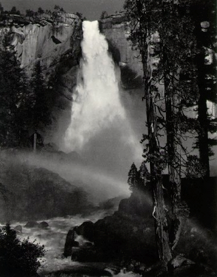
Photograph: Ansel Adams’ Nevada Fall, Rainbow, Yosemite Valley, 1947
Wednesday, July 27, 2011


The Inexpressible





